GSH-Glo™ Glutathione Assay
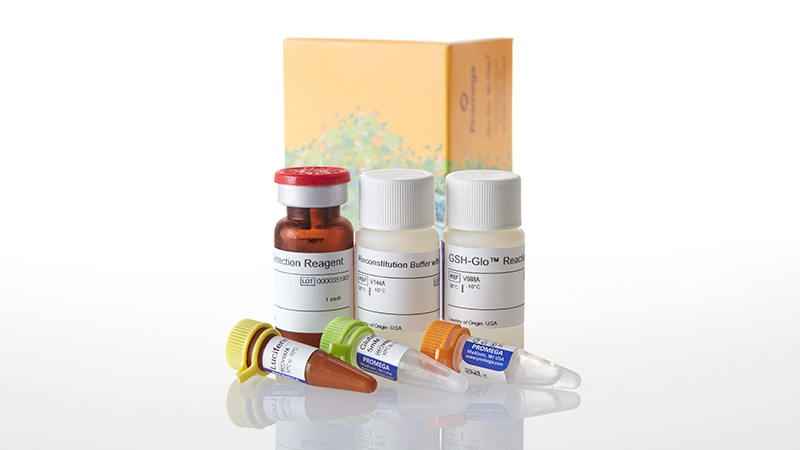
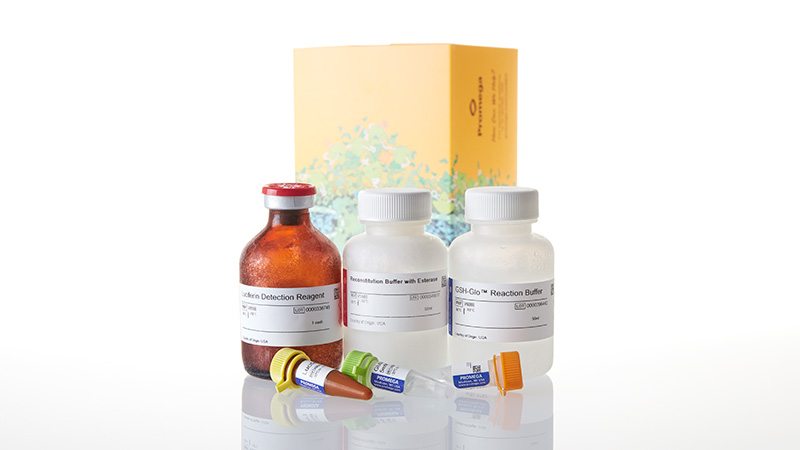
A Luminescent-Based Assay for the Detection and Quantification of Glutathione (GSH)
- Measure reduced (GSH) or total (GSSG + GSH) glutathione from cells and tissues
- Measure GSH levels directly from cell culture wells
- Excellent sensitivity and easily scalable


Catalog Number:
Size
Catalog Number: V6911
Catalog Number: V6912
Sensitively Detect Total and Reduced GSH in Cells
The GSH-Glo™ Assay is a luminescent-based assay for the detection and quantification of glutathione (GSH) in cells or in various biological samples. A change in GSH levels is important when assessing toxicological responses and an indicator of oxidative stress, potentially leading to apoptosis or cell death. The GSH detection assay is based on the conversion of a luciferin derivative into luciferin in the presence of GSH. The reaction is catalyzed by a glutathione S-transferase (GST) enzyme supplied in the kit. The luciferin formed is detected in a coupled reaction using Ultra-Glo™ Recombinant Luciferase that generates a glow-type luminescence that is proportional to the amount of glutathione present in cells. The GSH detection assay provides a simple, fast and sensitive alternative to colorimetric and fluorescent methods and can be adapted easily to high-throughput applications.
Want to measure the ratio of reduced to oxidized glutathione?
The GSH/GSSG-Glo™ Assay is a luminescent assay that can quantify total glutathione (GSH + GSSG), GSSG and GSH-to-GSSG ratios in cultured cells. Learn more.
The GSH-Glo™ Glutathione Assay
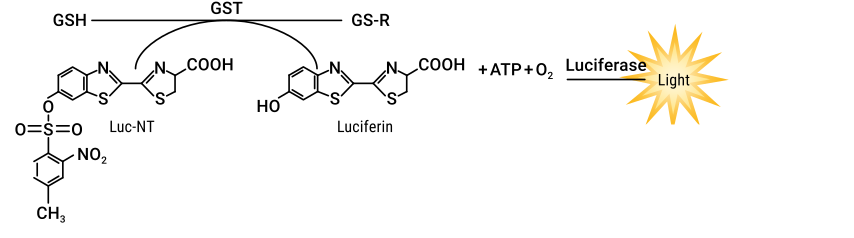
The GSH assay is performed in two steps. In the first step, cells are lysed in the presence of the luciferin-NT substrate and glutathione S-transferase. Glutathione in the cells drives the formation of luciferin. In the 2nd step, Luciferin Detection Reagent is added to produce light that is directly proportional to the amount of GSH in the reaction.
GSH Depletion and Recovery in Treated Cells
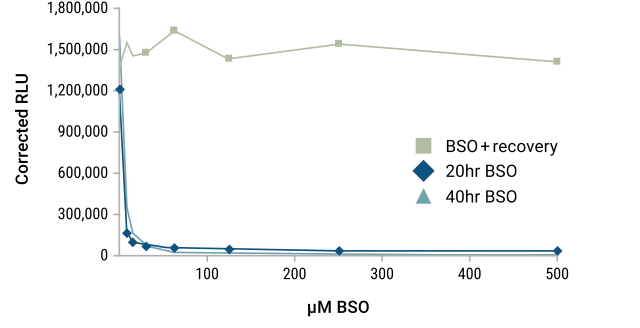
HeLa cells (5000 cells/well in 96 well format) were exposed to l-Buthionine-sulfoximine (BSO). BSO inhibits GSH synthesis, thus reducing cellular GSH level.
BSO + Recovery: Cells treated with BSO for 20 hours, washed 2X with PBS and covered with fresh media without BSO. Cells assayed for GSH after 40 hours.
20hr BSO: Cells treated with BSO and assayed for GSH after 20 hours.
40hr BSO: Cells treated with BSO, washed at 20 hours and fresh media plus BSO added. Cells assayed for GSH after 40 hours.
The simple two-reagent-addition GSH detection assay minimizes the number of assay steps compared to conventional GSH assays and is easily adapted to higher throughput applications. No deproteination step is required, and results are achieved in as quickly as 30 minutes.
The luminescent method of the GSH-Glo™ Glutathione Assay avoids inherent background fluorescence associated with other methods, thereby providing excellent signal-to-background ratios. A half-life greater than 5 hours results in a stable signal, enabling batch processing of many plates at once using the GSH-Glo™ Assay.
The GSH-Glo™ Assay is recommended for measurement of total glutathione levels in samples. To measure the ratio, we recommend the GSH/GSSG-Glo™ Assay.
GSH Depletion by Acetaminophen in Hepatocytes
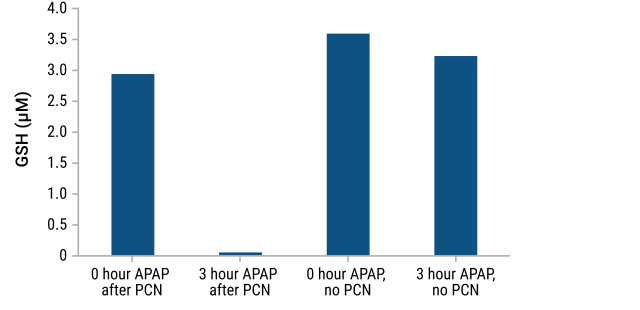
GSH levels in lysates from adherent cells in 24 well plates were measured with the GSH-Glo™ Glutathione Assay. GSH concentrations were determined by interpolation from a GSH standard curve generated using the bioluminescent system. Exposure to 5mM acetaminophen (APAP) for three hours substantially reduced GSH only after treatment for two days with a P450 inducer, 30 μM pregnenolone 16a-carbonitrile (PCN), whereas exposure to APAP or PCN alone caused little difference in GSH levels.
Protocols
Complete Protocol
Specifications
Catalog Number:
What's in the box?
| Item | Part # | Size |
|---|---|---|
Reconstitution Buffer with Esterase |
V144A | 1 × 10ml |
|
Luciferin-NT |
V687A | 1 × 100μl |
|
GSH-Glo™ Reaction Buffer |
V688A | 1 × 10ml |
|
Glutathione S-Transferase |
V689A | 1 × 100μl |
|
Glutathione, 5mM |
V690A | 1 × 100μl |
|
Luciferin Detection Reagent |
V859A | 1 × 1 each |
SDS
Search for SDSCertificate of Analysis
Use Restrictions
For Research Use Only. Not for Use in Diagnostic Procedures.Storage Conditions
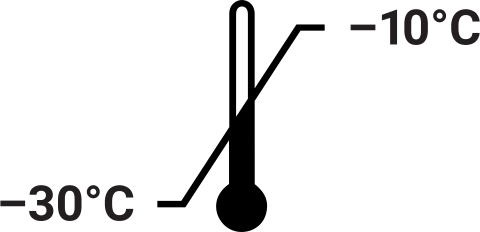
What's in the box?
| Item | Part # | Size |
|---|---|---|
Reconstitution Buffer with Esterase |
V144B | 1 × 50ml |
|
Luciferin-NT |
V687B | 1 × 500μl |
|
GSH-Glo™ Reaction Buffer |
V688B | 1 × 50ml |
|
Glutathione S-Transferase |
V689B | 1 × 500μl |
|
Glutathione, 5mM |
V690A | 1 × 100μl |
|
Luciferin Detection Reagent |
V859B | 1 × 1 each |
SDS
Search for SDSCertificate of Analysis
Use Restrictions
For Research Use Only. Not for Use in Diagnostic Procedures.Storage Conditions
Related Products
Similar Products
GSH/GSSG-Glo™ Assay
Homogeneous assay to quantify total glutathione and glutathione ratios.
V6611, V6612
Mitochondrial ToxGlo™ Assay
An effective assay for predicting potential mitochondrial dysfunction.
G8000, G8001
ROS-Glo™ H2O2 Assay
Sensitive, bioluminescent assay that measures the level of H2O2 in cell cultures.
G8820, G8821
CytoTox-Glo™ Cytotoxicity Assay
Highly sensitive luminescent cytotoxicity assay that measures the relative number of dead cells.
G9290, G9291, G9292
Frequently Used With
MultiTox-Glo Multiplex Cytotoxicity Assay
A fluorescent and luminescent assay that measures the relative number of live and dead cells in a population.
G9270, G9271, G9272
Caspase-Glo® 3/7 Assay System
An easy-to-use, plate-based luminescent assay for detecting caspase-3/7 activity.
G8090, G8091, G8093, G8092
GloMax® Discover System
High-performance microplate reader for detecting luminescence, fluorescence and absorbance.
GM3000